
How Athletes Recover from Ligament and Tendon Injuries Without Surgery?
You’re training for a marathon, playing your favourite sport, or simply pushing yourself during a workout when a sudden twist or awkward landing leaves you with pain. After hearing the words ligament or tendon injury, it’s natural to wonder, “Will I need surgery?”
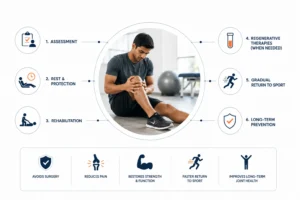
The good news is that not every ligament or tendon injury requires surgery. With advances in sports injury treatment, many athletes can recover through a personalised, non-surgical approach that may include rehabilitation, activity modification, and, in suitable cases, regenerative therapies. The right treatment depends on the type and severity of the injury, as well as early diagnosis and proper care.
Whether you’re a professional athlete, a weekend runner, or someone who enjoys staying active, understanding your injury is the first step towards recovery. Knowing what to expect, and which treatment options are available, can help you make informed decisions and return to the activities you enjoy with greater confidence.
In this blog, we’ll explore how athletes recover from ligament and tendon injuries, when ligament repair without surgery may be possible, and the treatment options that can help support a safe return to sport.
Reach Out for Expert Care
Understanding Ligament and Tendon Injuries
Before exploring recovery, it’s important to understand what ligaments and tendons are and why they’re so important for movement. Although these tissues are often mentioned together, they have different roles in keeping your body strong, stable, and active.
Ligaments are tough bands of connective tissue that connect one bone to another. They help stabilise joints and prevent excessive movement. Tendons, on the other hand, connect muscles to bones, allowing your muscles to move your joints when you walk, run, jump, or lift.
Both ligaments and tendons are designed to withstand significant stress, but sudden twists, awkward landings or repetitive movements during sports can cause them to stretch, strain, or tear. Depending on the severity of the injury, ligament injury treatment or tendon injury treatment may range from rest and rehabilitation to advanced non-surgical sports injury treatment, while some severe cases may require surgery.
Ligaments vs Tendons: What’s the Difference?
| Ligamets | Tendons |
| Connect bone to bone | Connect muscle to bone |
| Provide joint stability | Common injuries include ACL, MCL and ankle sprains |
| Common injuries include ACL, MCL and ankle sprains | Common injuries include Achilles tendon injuries, rotator cuff injuries and tennis elbow |
What Causes Ligament and Tendon Injuries in Athletes?
Whether you’re a professional athlete or someone who enjoys staying active, ligament and tendon injuries can happen to anyone. While some injuries occur suddenly during a match or workout, others develop gradually due to repeated stress over time.
Some of the most common causes include:
- Sudden twisting or pivoting movements, especially during sports like football, basketball, and badminton.
- Overuse and repetitive strain from activities such as running, tennis, swimming, or weight training.
- Poor warm-up or inadequate recovery, which can increase the risk of injury.
- Weak muscles or poor movement mechanics, placing extra stress on joints and tendons.
- Previous injuries, which may make the affected area more vulnerable to future problems.
Athletes often place high demands on their bodies, making it important to recognise early warning signs rather than pushing through pain. Early assessment and appropriate sports injury treatment can help prevent a minor strain from progressing into a more serious injury that may require a longer recovery period.
Can Ligament and Tendon Injuries Heal Without Surgery?
The answer is yes, in many cases, they can. Not every ligament or tendon injury requires surgery. Mild sprains, strains, and some partial ligament tears can often heal with the right combination of rest, rehabilitation, activity modification, and personalised medical care. However, the most appropriate treatment depends on the type of injury, its severity, the affected joint, and your activity level.
The goal of ligament repair without surgery is to support the body’s natural healing process while restoring strength, stability, and function. Similarly, tendon injury treatment without surgery often focuses on reducing pain, improving mobility, and gradually rebuilding strength through a structured rehabilitation programme.
That said, not all injuries are the same. Complete ligament tears, significant joint instability, or injuries that don’t improve with conservative treatment may require surgical evaluation. This is why an early assessment by a healthcare professional is important to determine the most appropriate treatment plan and help you return to your sport safely.
Can Regenerative Treatments Support Recovery?
In some cases, conventional treatments such as rest, rehabilitation, and physiotherapy may be enough. However, for certain athletes with persistent symptoms or slower healing, regenerative medicine may be considered as part of a personalised treatment plan.
These treatments are designed to support the body’s natural healing response and are recommended only after a thorough clinical evaluation.
These are as follows:
SCP (Super Concentrated Platelets) Therapy
SCP therapy for sports injuries is an advanced platelet-based treatment with a higher concentration of platelets than conventional PRP. In selected patients, it may be considered to support recovery from certain ligament and tendon injuries.
BMAC (Bone Marrow Aspirate Concentrate) Therapy
BMAC therapy for sports injuries uses cells obtained from the patient’s bone marrow, along with growth factors and other biological components. Depending on the injury and individual assessment, it may be recommended to support healing in certain complex or chronic cases.
PRP (Platelet-Rich Plasma) Therapy
PRP for ligament injuries involves using a concentrated sample of the patient’s own platelets, which contains natural growth factors that may support tissue healing in suitable cases.
Note: Regenerative treatments are not suitable for everyone. The choice of treatment depends on the type of injury, its severity, activity level, and overall health, following a detailed evaluation by a qualified specialist.
How Long Does Recovery Usually Take?
One of the most common questions athletes ask is, “How long will it take before I can get back to my sport?” The answer depends on several factors, including the type of injury, its severity, your overall health, and how consistently you follow your rehabilitation programme.
While ligament tear recovery time without surgery varies from person to person, here’s a general idea:
| Injury | Approximate Recovery Time |
| Mild ligament sprain | A few weeks |
| Moderate ligament injury | Several weeks to a few months |
| Mild tendon injury | A few weeks |
| Moderate tendon injury | Several weeks to a few months |
These are general estimates. Recovery time varies depending on the individual and should be guided by a healthcare professional.
Rather than focusing solely on returning quickly, the priority should be returning safely. Allowing the injured ligament or tendon to heal properly can help reduce the risk of recurring injuries and support long-term performance.
When Is Surgery the Better Option?
While many ligament and tendon injuries can be managed without surgery, there are situations where an operation may be the most appropriate treatment. The decision depends on the type of injury, its severity, your activity level, and your recovery goals.
Surgery may be recommended if you have:
- A complete ligament or tendon tear.
- Significant joint instability or loss of function.
- Persistent symptoms despite appropriate non-surgical treatment.
- An injury that prevents you from safely returning to your sport.
The best treatment plan is always based on a thorough clinical evaluation. Discussing your symptoms, lifestyle, and sporting goals with a specialist can help determine the most appropriate approach for your recovery.
When Should You See a Sports Injury Specialist?
It’s easy to dismiss a ligament or tendon injury as “just a sprain” and hope it gets better on its own. However, if your pain persists, keeps returning, or affects your ability to train or perform everyday activities, it’s important to seek medical advice rather than pushing through it.
Consider consulting a sports injury specialist in Delhi NCR if you experience:
- Pain that doesn’t improve after a few weeks of rest and rehabilitation.
- Recurrent swelling or joint instability.
- Difficulty walking, running, or returning to your usual activities.
- A suspected ligament or tendon tear.
- An injury that’s affecting your sports performance or quality of life.
The Bottom Line
A ligament or tendon injury doesn’t always mean surgery is the only option. With an accurate diagnosis, a structured rehabilitation programme, and, where appropriate, advanced non-surgical treatments, many athletes can recover safely and return to the activities they enjoy.
The key is to avoid rushing the healing process and seek timely medical advice if symptoms persist. The right treatment at the right time can make all the difference in supporting a safe recovery and long-term joint health.

 WhatsApp