
Sports Injuries: When Surgery Is Necessary and When It’s Not
Injured while playing sports or working out? Before you assume you need surgery, know that many sports injuries can heal without an operation. The key is getting the right diagnosis and choosing the most appropriate treatment at the right time.
If you’re looking for one of the best pain management specialists in Delhi-NCR, Dr Namrata Dabas offers comprehensive evaluation and personalised treatment for sports injuries, with a non-surgical-first approach whenever appropriate, to help patients recover safely and return to an active lifestyle.
Keep reading to learn when surgery is truly necessary, which sports injuries can be treated without surgery, and how to choose the right treatment for a faster, safer recovery.
Reach Out for Expert Care
What Are Sports Injuries?
- Injuries which happen when engaging in physical exercise or taking part in any sports activity fall under the category of sports injuries.
- They involve damage to muscles, ligaments, bones, joints, tendons, cartilage, and other soft tissues.
- Sports injuries may be sudden, due to an accident, or gradual, due to repetitive motion or strain.
- Even though athletes are the commonest victims of sports injuries, anybody else who participates in any form of physical activity, including gym users and recreational players, is also at risk.
- Some factors that contribute to sports injuries include lack of proper warm-up exercises, wrong technique while exercising, overtraining, use of incorrect equipment, and muscle imbalance, among others.
- The seriousness of sports injuries varies from one case to another.
- Some injuries need time to heal, whereas others need surgery.
- The diagnosis of sports injuries plays an important role in deciding what method of treatment to apply.
Types of Sports Injuries
A few common sports Injuries are classified into two broad categories:
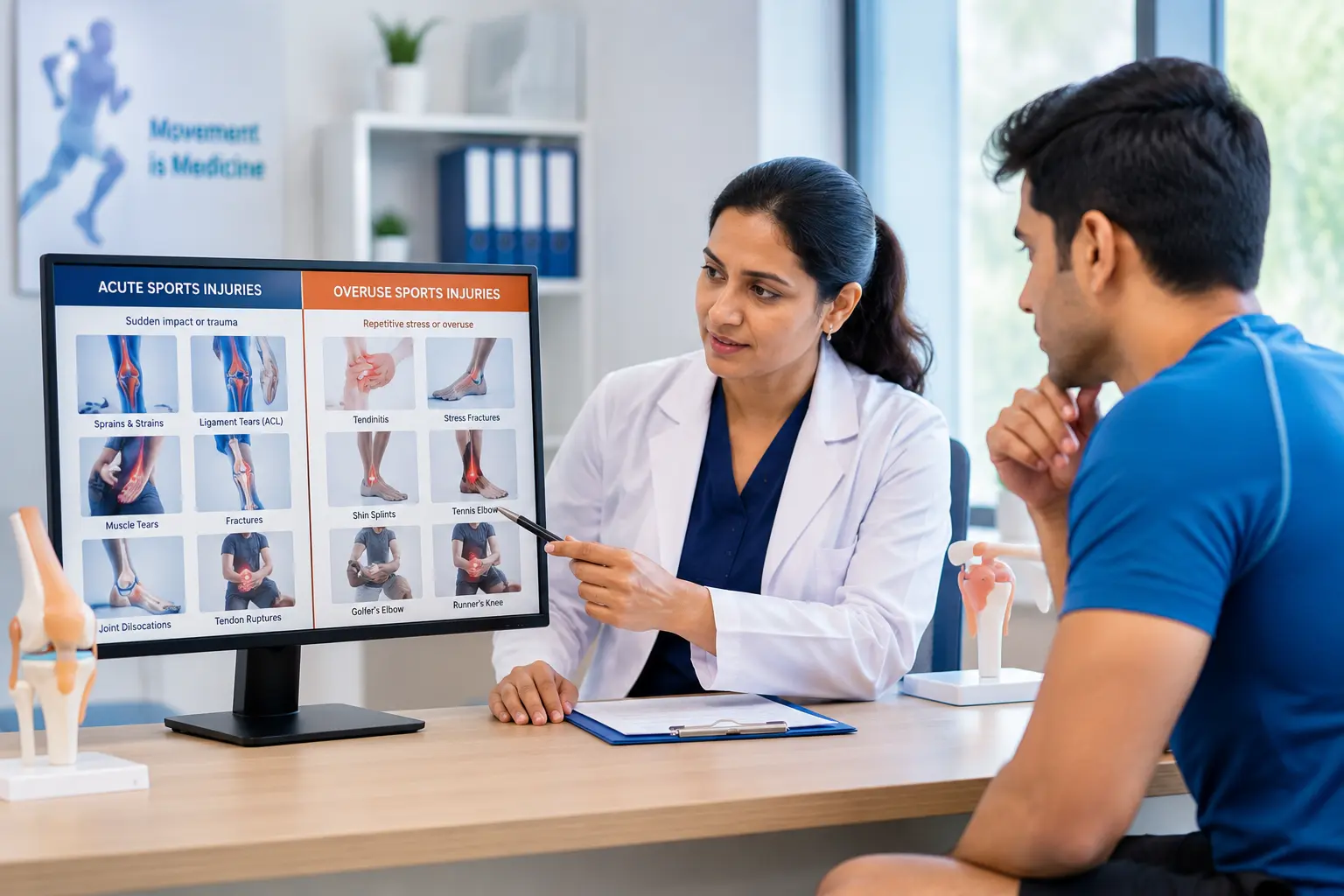
Acute Sports Injuries
- An acute sports injury happens as a result of a direct incident, such as a fall, impact, poor landing technique, or twisting motion.
- These injuries typically present symptoms of immediate pain, inflammation, bruising, or inability to move the affected part.
- Examples include sprains and strains, ligament tears (such as ACL injuries), muscle tears, fractures, joint dislocations, and tendon ruptures.
Overuse Sports Injuries
- These injuries happen slowly through repetitive actions or excess load on muscles, bones, joints, or tendons that do not have sufficient time to heal from these activities.
- Examples include tendinitis, stress fractures, shin splints, tennis elbow, golfer’s elbow, runner’s knee, and rotator cuff tendinopathy.
It is essential to understand whether the injury is acute or an overuse injury to choose how the patient should be treated. Many cases of overuse injuries and minor acute injuries can be treated conservatively without resorting to surgery. However, significant tissue damage, joint instability, or bone fractures may need surgical intervention.
Can Sports Injuries Be Treated Without Surgery?
- Many kinds of sports injuries do not necessarily require surgical procedures for successful treatment, particularly if they are detected early enough and subjected to the proper rehabilitation program.
- Non-surgical intervention involves minimising pain, accelerating the process of healing, and regaining strength and flexibility.
- Many mild to moderate sports injuries, such as sprains, strains, tendinitis, tennis elbow, runner’s knee, minor meniscus tears, stable fractures, and shoulder impingement, can often be treated successfully without surgery through appropriate conservative care.
A few non-surgical options for sports injuries include:
- Rest and activity modification
- RICE therapy (Rest, Ice, Compression, and Elevation)
- Physiotherapy and rehabilitation
- Bracing or splinting
- Pain-relieving and anti-inflammatory medications
- Regenerative therapies such as PRP, SCP, and BMAC (for selected cases)
- Image-guided injections
- Gradual return-to-sport programme
Surgical Treatment Options for Sports Injuries in Delhi NCR
Surgery is not the first-line treatment for most sports injuries. It is generally recommended only when there is significant structural damage, persistent symptoms despite comprehensive non-surgical treatment, or when the injury causes joint instability, loss of function, or prevents a safe return to sports.
Complex sports injuries that are more likely to require surgery include complete ligament tears (such as ACL injuries), complex meniscus tears, complete tendon ruptures, recurrent shoulder dislocations, displaced or unstable fractures, severe cartilage injuries, and large rotator cuff tears.
Surgery may also be recommended if symptoms persist despite appropriate non-surgical treatment for sports injury or if the injury significantly affects joint stability, function, or athletic performance.
A few common surgical treatment procedures for sports injuries include:
- Arthroscopic (keyhole) surgery for joint injuries
- Ligament reconstruction (e.g., ACL reconstruction)
- Meniscus repair or partial meniscectomy
- Tendon repair surgery
- Fracture fixation using plates, screws, rods, or pins
- Cartilage restoration procedures
- Joint stabilisation surgery for recurrent dislocations
The most appropriate surgical procedure depends on the type and severity of the injury, the patient’s activity level, and their recovery goals. A structured rehabilitation programme after surgery is essential for restoring strength, mobility, and function.
Factors Doctors Consider Before Recommending Surgery
Surgeries are done depending on careful considerations of patients’ conditions and their needs. The following are some of the things that doctors take into account when considering surgeries for their patients:
- Severity of the injuries: Injuries such as complete tears, unstable fractures, or torn cartilage will definitely be treated using surgery.
- Age and overall health: Health status and recuperation capability are important in determining the best way of treating patients.
- Degree of physical activity: Professional athletes are likely to have surgeries if they want to perform their duties perfectly again.
- Joint stability and performance: Joint problems will make patients have joint surgeries.
- Response to conservative treatment: Surgery may be considered if symptoms continue despite adequate non-surgical management.
- Goals of patients: It will depend on whether patients need to engage in sports or just move without pain.
Non-Surgical vs Surgical Treatment: A Comparison
- Treatment of injuries sustained from sports activities is usually done using both non-surgical treatment methods and surgical intervention procedures.
- While non-surgical methods prove very efficient in the case of mild and moderate injuries, it might become inevitable to perform surgery in case of serious injuries. Here is the tabular comparison for both
| Factor | Non-Surgical Treatment | Surgical Treatment |
| Best For | Mild to moderate injuries | Severe or unstable injuries |
| Treatment Methods | Rest, physiotherapy, medications, bracing, PRP/SCP/BMAC | Arthroscopy, ligament reconstruction, tendon repair, fracture fixation |
| Recovery Time | Usually shorter | Generally longer and depends on the procedure |
| Hospital Stay | Usually not required | May require day-care or short hospital stay |
| Rehabilitation | Physiotherapy and gradual return to activity | Essential after surgery for optimal recovery |
| Goal | Relieve pain and restore function without surgery | Repair damaged structures and restore joint stability |

 WhatsApp