
Cancer Pain Treatment in Delhi-NCR
If you or someone you love is living with cancer, pain should never be accepted as “part of the journey.” Cancer pain is real, it is common, and in most cases it can be controlled. With the right care, cancer pain can be eased, and many patients find they can return to everyday comforts they thought they had lost.
This page explains what causes cancer pain, how it is assessed and the treatment options available, from carefully chosen medicines to advanced nerve blocks and other interventional procedures.

Reach Out for Expert Care
What Is Cancer Pain, and Why Does It Happen?
Cancer pain is pain caused by the cancer itself, by its treatment, or by related changes in the body. It affects many people with cancer, and it can be treated.
Cancer pain does not feel the same for everyone. It depends on the type and stage of cancer, where it has spread and how your body responds to treatment. Broadly, it comes from three sources:
- The tumour itself: A growing tumour can press on nerves, bones, muscles or organs. This is common in cancers of the pancreas, bone, spine, lung and head and neck.
- Cancer treatment: Surgery, chemotherapy and radiation can all leave pain behind. Examples include nerve damage (neuropathy), scar pain and burning or tingling after radiation.
- Related problems: Muscle stiffness, long periods in bed, infections or nerve irritation can add to the discomfort.
Understanding the cause matters because it decides which treatment will work best. Pain from a tumour pressing on a nerve, for example, needs a different approach from pain caused by chemotherapy.
In short: Cancer pain has identifiable causes, and finding the right one is the first step to treating it well.
What Are the Types of Cancer Pain?
The main types of cancer pain are nociceptive (from tissue or bone), neuropathic (from nerves), and breakthrough pain (sudden flare-ups). Many patients have more than one type at the same time.
Describing your pain accurately helps us treat it more precisely. Here is what each type usually feels like:
- Bone and tissue pain: A deep, dull, aching or gnawing pain, often worse with movement. This is typical in bone metastasis.
- Nerve pain: Burning, shooting, electric-shock or pins-and-needles sensations. This may follow chemotherapy or occur when a tumour presses on a nerve.
- Visceral pain: A deep, cramping or pressure-like pain in the abdomen or chest. It is often hard to point to one spot.
- Breakthrough pain: A sudden spike of pain that breaks through the regular pain medicines, even when the baseline pain is controlled.
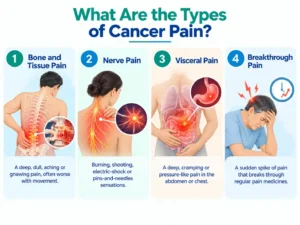
Doctors often use different words for these, but you do not need to know the terms. Simply tell us how it feels, when it comes and what makes it better or worse.
In short: Knowing which type of pain you have helps us choose treatments that actually work for you.
When Should You See a Cancer Pain Specialist?
You should see a cancer pain specialist when pain is affecting your sleep, appetite, movement or mood, or when your current medicines are no longer controlling it.
Many patients wait too long. They worry about “troubling” their oncologist or fear that asking for pain relief means something is getting worse. Neither is true. Pain control is a part of good cancer care.
Consider seeking a specialist opinion if:
- Pain keeps you awake at night or stops you from eating
- Your pain medicines cause drowsiness, nausea or constipation that you can’t tolerate
- Pain is increasing despite regular medicines
- You have sudden flares that medicines can’t catch in time
- You feel tingling, numbness or burning after chemotherapy or radiation
- You find yourself avoiding activities or time with family because of pain
Families and caregivers are welcome, and often essential, in these consultations.
In short: If pain is limiting your daily life, a pain specialist can help, and the earlier you ask, the better.
How Is Cancer Pain Diagnosed and Assessed?
Cancer pain is assessed through a detailed conversation, a physical examination, and a review of your scans and treatment history. The aim is to understand where, why and how the pain is affecting your life.
At your first visit, your pain physician will ask about:
- Where the pain is and how strong it feels on a simple 0 to 10 scale
- What it feels like: dull, sharp, burning or cramping
- What makes it better or worse, and how it affects your sleep, appetite and mood
- Your cancer type, stage, ongoing treatment and current medicines
- What matters most to you, such as sleeping through the night, sitting comfortably or walking to the garden
We also look at your reports and scans, and where needed, we work directly with your oncologist. The goal is a clear plan, not a long list of confusing options.
In short: A careful assessment lets us build a pain plan around you rather than around a standard formula.
How Is Cancer Pain Treated in Delhi-NCR?
Cancer pain is treated with a combination of medicines, interventional procedures like nerve blocks, and supportive therapies. The right mix depends on the type, location and cause of the pain.
There is rarely a single answer. Good cancer pain care works in steps and layers, and we adjust the plan as your needs change. The options include:
- Medicines, carefully chosen and monitored
This includes simple pain relievers, nerve pain medicines and, when needed, opioids. Used correctly and under supervision, these can bring strong relief. We focus on the lowest effective dose and manage side effects such as constipation, nausea and drowsiness. - Interventional pain procedures
When medicines alone are not enough, or cause too many side effects, targeted procedures can help. These are done with image guidance for accuracy and safety, and they often provide relief that is longer-lasting and more focused. They are covered in detail in the next section. - Treatment for specific problems
- Bone metastasis pain: medicines, procedures and coordination with radiation or bone-strengthening therapy
- Chemotherapy-induced neuropathy: nerve pain medicines and targeted therapies to reduce burning and numbness
- Post-radiation and post-surgical pain: nerve-focused treatment for scar pain and long-standing discomfort
- Supportive care
Gentle movement and positioning advice, relaxation and breathing techniques, and guidance for caregivers on comfort at home.
In short: Layered, personalised treatment gives better relief with fewer side effects than medicines alone.
What Interventional Procedures Help with Cancer Pain?
Interventional procedures for cancer pain include nerve blocks, neurolytic blocks, spinal procedures and, in select cases, intrathecal pumps. They target the source of pain directly and can reduce the need for high medicine doses.
These are minimally invasive, usually done as day-care procedures, and guided by ultrasound or X-ray imaging. Common options include:
- Nerve blocks: A medicine is placed near the nerve that carries pain signals, reducing the pain message reaching the brain.
- Celiac plexus and other sympathetic blocks: Often helpful in upper abdominal pain, particularly from pancreatic and other abdominal cancers.
- Neurolytic blocks: For advanced cancer pain, a longer-acting agent is used to interrupt pain-carrying nerves for a longer period.
- Spinal and epidural procedures: Help with pain from the back, spine or limbs, including nerve compression.
- Intrathecal drug delivery: In carefully selected patients, a small pump delivers very small doses of medicine directly to the spinal fluid, often with fewer side effects.
Not every patient needs a procedure, and not every procedure suits every patient. We discuss benefits, limits and risks openly, and we decide together.
In short: Targeted procedures can switch off pain at its source, often giving relief when medicines alone fall short.
Will Cancer Pain Treatment Make Me Drowsy or Dependent on Medicines?
Not necessarily. With careful dosing, regular review and the right combination of treatments, most patients get good relief while staying alert and active.
This is one of the biggest worries for patients and families. Pain specialists work to find the balance: enough relief to live comfortably, with as few side effects as possible. This is done by:
- Combining different types of treatment so that no single medicine has to be pushed to high doses
- Using procedures where suitable to reduce medicine load
- Reviewing the plan regularly and adjusting it as your condition changes
- Managing side effects early, rather than waiting for them to worsen
Pain control is also not a sign of “giving up.” It helps you stay strong enough to continue cancer treatment, eat better and rest properly.
In short: The goal is comfort with clarity, relief that does not take away your ability to enjoy your day.
Why Choose Dr. Namrata Dabas for Cancer Pain Management?
Dr. Namrata Dabas is a pain management and regenerative medicine specialist who offers personalised, image-guided cancer pain care across Delhi, Gurugram and Sonipat, with a focus on comfort, dignity and quality of life.
What patients and families can expect:
- A listening-first approach: Your pain, your priorities and your family’s concerns come first.
- Advanced, minimally invasive options: Image-guided nerve blocks and interventional procedures, performed with precision and care.
- Close coordination with your oncology team: Pain care that works alongside your cancer treatment, not apart from it.
- Clear communication: Plain-language explanations of what is happening, what the options are and what to expect.
- Whole-person support: Attention to sleep, mood, movement and caregiver needs, not only the pain score.
In short: You get a specialist who treats the person, not just the pain.
Where Can You Get Cancer Pain Treatment in Delhi-NCR?
Dr. Namrata Dabas sees patients for cancer pain at Manipal Hospital Dwarka, Manipal Hospital Palam Vihar in Gurugram, and Manipal Jivisha Cancer Centre in Sonipat.
Cancer care is tiring enough without long travel. That is why consultation and treatment are available at multiple locations across Delhi-NCR:
- Dwarka, New Delhi: Consultations at Manipal Hospital Dwarka
- Sonipat, Haryana: Procedures at Manipal Jivisha Cancer Centre
- Gurugram, Haryana: Consultations at Manipal Hospital Palam Vihar
Patients regularly travel from Rohtak, Panipat, Karnal and other parts of Haryana and Delhi-NCR for expert cancer pain care.
You Don’t Have to Live With Cancer Pain: Take the First Step Towards Relief Today
Cancer pain is treatable, and seeking help is a sign of strength, not weakness. With the right care, many patients experience better sleep, improved appetite and more comfortable days, so that time can go to what matters most: family, rest and recovery.
If you or a loved one is struggling with pain, you do not have to wait for it to get worse before asking for help. Dr. Namrata Dabas offers compassionate, personalised cancer pain treatment in Delhi-NCR, with consultations at Dwarka and Gurugram, and procedures at Sonipat or you may consult your preferred pain specialist. Every plan is designed around your cancer, your comfort and your goals, and your family is welcome at every step.
Medical Disclaimer: This page is for general information and does not replace medical advice. Treatment depends on your cancer type, stage, overall health and other factors. Please consult Dr. Namrata Dabas or your oncology team for advice specific to you.
Frequently Asked Questions
Can cancer pain medicines become addictive, and should my family be worried about this? expand_more
When cancer pain medicines, including opioids, are prescribed and monitored by a doctor, addiction is uncommon. Your body may get used to them (tolerance), which is different from addiction. Take them only as advised, share any concerns openly, and never stop suddenly. Your pain specialist will review the dose regularly and adjust it safely.
Is it normal to feel more pain at night, and what can we do about it? expand_more
Yes, many patients feel pain more at night. It is quieter, there are fewer distractions, and medicine doses may wear off. Lying flat can also worsen some pain, especially bone pain. Tell your doctor, as small changes, such as adjusting medicine timing, using long-acting medicines or changing sleeping positions, often help.
Can my oncologist and pain specialist treat me together at the same time? expand_more
Yes, and this is often the best approach. Your oncologist treats the cancer, while your pain specialist focuses on comfort. The two teams can share reports and plans so that pain treatment fits safely alongside chemotherapy, radiation or surgery. Better pain control can also help you stay strong for ongoing cancer treatment.
How soon will I feel relief after a cancer pain procedure? expand_more
It depends on the procedure and the cause of pain. Some patients notice relief within hours to a few days, while others improve gradually over a week or two. Relief can last from weeks to months. Your doctor will explain what to expect for your specific procedure and how to manage pain in the meantime.
Can acupuncture, yoga or massage help with cancer pain, or are they unsafe? expand_more
These can be helpful alongside medical treatment, but they should not replace it. Gentle yoga, relaxation and light massage may ease pain and stress. Avoid deep massage over tumour sites or bone metastasis, and be cautious with acupuncture if your blood counts are low. Always check with your oncologist first.

Dr. Namrata Dabas's Medical Content Team
Dr. Namrata Dabas’s medical content team specialises in creating accurate, clear, and patient-focused healthcare content. With strong clinical understanding and expertise in technical writing and SEO, the team translates complex medical information into reliable, accessible resources that support informed decisions and uphold Dr. Namrata Dabas’s commitment to quality care.
This content is reviewed by Dr. Namrata Dabas
 WhatsApp