
Radiofrequency Ablation in Delhi-NCR
Radiofrequency Ablation (RFA) is a minimally invasive, image-guided procedure that uses controlled heat energy to block pain signals from a specific nerve. It’s commonly used to treat chronic back, neck, knee, and joint pain that hasn’t improved with medication or physiotherapy, offering long-term relief without surgery.
Living with chronic pain changes more than just how your body feels; it affects your sleep, your work, your mood, and your ability to simply enjoy everyday moments with family. Many patients try medications, physiotherapy, and injections first, only to find the relief is partial or temporary, leaving them stuck between ongoing discomfort and the idea of surgery.
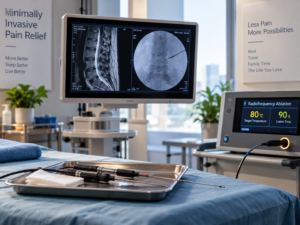
Radiofrequency Ablation (RFA) offers a middle path: a non-surgical, image-guided treatment that targets the exact nerve causing your pain, rather than simply masking the symptoms. Dr. Namrata Dabas, an interventional pain specialist with 20+ years of experience, has helped hundreds of patients across Gurugram, Delhi, Dwarka, Sonipat, and the wider NCR region find lasting relief through RFA, often restoring the mobility and quality of life they thought they’d lost for good.
In this procedure page, you’ll learn how RFA works, which conditions it treats, and whether you might be a good candidate along with what the procedure, recovery, and cost typically look like.
Reach Out for Expert Care
What Is Radiofrequency Ablation and How Does It Work?
Radiofrequency Ablation (RFA) is a minimally invasive, image-guided procedure that uses controlled heat energy to block pain signals from a specific nerve. It’s typically recommended for patients whose chronic pain hasn’t responded to medication, physiotherapy, or injections and who want to avoid or delay surgery.
Here’s how it works, step by step:
- A diagnostic nerve block and imaging first confirm the exact nerve causing your pain.
- A thin needle is guided precisely to that nerve using X-ray or ultrasound.
- Controlled radiofrequency energy is delivered through the needle, interrupting the nerve’s pain signal while leaving surrounding tissue undisturbed.
Because it targets the exact source of pain rather than masking symptoms, RFA often provides more meaningful, longer-lasting relief than medication alone and unlike surgery, it requires no incisions, stitches, or general anaesthesia.
Which Conditions Can Be Treated with Radiofrequency Ablation?
RFA is a versatile treatment used across a wide range of chronic pain conditions, particularly those linked to the spine, joints, and specific nerves. Dr. Namrata Dabas commonly recommends RFA for:
- Chronic neck pain
- Chronic back pain
- Knee osteoarthritis pain
- Cervical spondylosis
- Facet joint pain
- Sacroiliac (SI) joint pain
- Trigeminal neuralgia
- Other nerve-related chronic pain conditions
If your pain falls into one of these categories and hasn’t responded well to conservative treatment, RFA is worth discussing at your next consultation.
What Are the Signs You May Need RFA Treatment?
Chronic pain often builds up gradually, which can make it hard to know when it’s time to explore a more advanced treatment option. You may be a good candidate for RFA if you’re experiencing:
- Pain that has lasted several months despite treatment
- Little or no relief from medication or physiotherapy
- Recurring neck, back, or joint pain that keeps coming back
- Difficulty walking, standing, or completing daily tasks
- Pain that disrupts your sleep or overall quality of life
- Short-lived relief from previous pain injections
- A strong preference to avoid spine or joint surgery
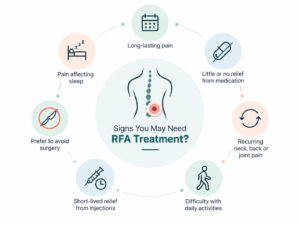
If several of these sound familiar, it’s a good sign that your pain has moved beyond what medication or rest alone can manage and a consultation can help clarify your next step.
How is a Patient Evaluated for RFA Treatment?
Not every patient with chronic pain is automatically a candidate for RFA, a careful, personalised evaluation comes first to confirm exactly which nerve is responsible for your pain. Dr. Namrata Dabas’s evaluation process typically includes:
- Clinical pain assessment: Understanding your pain history and pattern
- Physical examination: Checking mobility, strength, and pain triggers
- Imaging review: MRI or X-ray to confirm the pain source
- Diagnostic nerve block: A test injection to confirm the exact nerve causing pain
- Review of prior treatments: What’s worked, what hasn’t, and why
This step-by-step evaluation matters because RFA works best when it’s targeted at precisely the right nerve and this process is what makes that possible.
What Happens During a Radiofrequency Ablation Procedure?
Knowing what to expect during a radiofrequency ablation procedure can make it feel far less daunting. RFA is typically performed as a same-day procedure.
This procedure is performed in four stages, which are as followed:
- Diagnostic assessment – The nerve generating your pain is confirmed through examination, imaging, and often a diagnostic nerve block.
- Image-guided positioning – A specialised needle is precisely guided to the target nerve using fluoroscopy or ultrasound.
- Controlled radiofrequency energy – Energy is applied to the nerve to interrupt pain signals, while carefully preserving surrounding structures.
- Same-day recovery – Most patients go home the same day and gradually resume normal activities as advised.
Most patients describe the procedure itself as far more manageable than they expected, with only mild, temporary soreness afterward.
What Are the Benefits of Radiofrequency Ablation?
For patients who’ve been managing chronic pain for months or years, RFA offers a meaningful shift, treating the source of pain rather than simply covering it up. Key benefits include:
- Minimally invasive (no large incisions or stitches)
- Shorter recovery time compared to surgery
- Targeted, long-lasting pain relief
- Reduced dependence on daily pain medication
- Improved mobility and day-to-day function
- May help patients delay or avoid surgery altogether
Together, these benefits are why RFA has become a preferred option for patients looking to regain function without committing to a surgical procedure.
What Is the Cost of Radiofrequency Ablation in Delhi-NCR?
The cost of RFA varies from patient to patient, so it’s natural to want a clearer picture before deciding to go ahead. Several factors influence the final cost, including:
- The specific nerve or joint being treated, and the number of levels involved
- Whether one session or a combination of sessions is required
- The hospital or centre where the procedure is performed
- Pre-procedure diagnostics, such as imaging or diagnostic nerve blocks
- Hospital admission and day-care charges, where applicable
Because RFA is a personalized procedure, the most accurate cost estimate comes from an in-person consultation with Dr. Namrata Dabas, where your specific condition, imaging, and treatment plan are reviewed. Many hospitals also offer cashless or insurance-supported options, our team can help you understand what applies in your case.
What Are the Risks of Radiofrequency Ablation?
Like any medical procedure, RFA carries some risks, though serious complications are uncommon when performed by an experienced specialist.
These may include:
- Infection at the needle site
- Bleeding or bruising
- Rarely, temporary nerve irritation
Dr. Namrata Dabas will walk you through your individual risk profile, what to watch for during recovery, and post-procedure care instructions during your consultation,so you go into the procedure fully informed and confident.
Why Choose Dr. Namrata Dabas for RFA Treatment in Delhi-NCR?
Choosing the right specialist matters just as much as choosing the right procedure. With so many pain management providers across Delhi-NCR, it’s natural to want reassurance you’re in the right hands. RFA outcomes depend heavily on precision, accurate diagnosis, correct nerve targeting, and careful technique.
Patients continue to choose Dr. Namrata Dabas for her:
- 20+ years of experience in interventional pain management
- Advanced, minimally invasive RFA techniques
- Image-guided precision for improved safety and accuracy
- Personalised pain management plans tailored to your specific pain source
- Focus on long-term relief and restored mobility, not just symptom masking
This combination of experience and a personalised approach is what allows her patients to move forward with confidence, rather than uncertainty.
Consultation Centres for RFA Treatment in Delhi-NCR
Dr. Namrata Dabas consults at leading hospitals across Delhi-NCR, with advanced interventional procedures carried out at her dedicated centre in Sonipat. Patients from Dwarka, Gurgaon, Sonipat and nearby areas can easily access expert care along with follow-up support.
RFA Consultation in Dwarka
Visit Manipal Hospital, Dwarka, for a thorough evaluation, diagnosis, and a treatment plan tailored to your specific pain condition.
RFA Treatment & Procedures in Sonipat
Advanced procedures such as Radiofrequency Ablation, diagnostic nerve blocks, and related interventional treatments are performed at Manipal Jivisha Cancer Centre, Sonipat, along with dedicated follow-up care.
RFA Consultation in Gurgaon
Consult Dr. Namrata Dabas at Manipal Hospital, Palam Vihar, Gurugram, for a thorough assessment and a personalised RFA treatment plan.
Patients travelling from Rohtak, Panipat, Karnal, and other parts of Haryana and Delhi-NCR regularly visit these centres for evaluation, treatment, and continued care.
Ready to Take the Next Step?
Chronic pain doesn’t have to be something you just “live with.” If medications, physiotherapy, or injections haven’t given you lasting relief, Radiofrequency Ablation with Dr. Namrata Dabas could be the next right step toward getting your mobility, sleep, and daily life back on track.
Book your consultation today and take the first step toward moving and living without the ache.
Medical Disclaimer: The information on this page is provided for educational purposes only and should not be used as a substitute for medical advice. Treatment recommendations vary from person to person and should always be based on an individual consultation and clinical evaluation by a qualified healthcare professional.
Frequently Asked Questions
What is Radiofrequency Ablation used for? expand_more
Radiofrequency Ablation (RFA) is commonly used to treat chronic neck pain, back pain, knee arthritis pain, nerve pain, and facet joint-related pain conditions.
Which doctor should I consult for RFA treatment in Gurugram? expand_more
Patients with chronic pain not improving with medications or physiotherapy should consult a pain management specialist experienced in Radiofrequency Ablation procedures.
Is Radiofrequency Ablation a surgery? expand_more
No. RFA is a minimally invasive, non-surgical pain management procedure usually performed as a day-care treatment.
How long does pain relief from RFA last? expand_more
Pain relief duration varies depending on the condition and individual response, but many patients experience relief lasting several months to over a year.
Is Radiofrequency Ablation painful? expand_more
The procedure is generally well tolerated and performed under local anaesthesia or sedation. Mild soreness after treatment may occur temporarily.
Can RFA help avoid spine or knee surgery? expand_more
In selected patients, RFA may help reduce pain significantly and delay or avoid surgery by improving function and quality of life.
What conditions can be treated with Radiofrequency Ablation? expand_more
RFA may be used for chronic neck pain, back pain, knee osteoarthritis, trigeminal neuralgia, facet joint pain, and certain nerve-related pain conditions.
When should I consider Radiofrequency Ablation for chronic pain? expand_more
You may consider RFA if chronic pain persists despite medications, physiotherapy, injections, or other conservative treatments.
How long does it take to feel pain relief after RFA? expand_more
Some patients notice improvement within the first few days, while for others it can take up to two to three weeks as the nerve's pain signal fully settles. Mild soreness at the treatment site during this window is normal and usually resolves on its own.
How many RFA sessions are usually needed for lasting pain relief? expand_more
Most patients need a single RFA session per treated nerve to experience significant relief. However, some patients may benefit from a repeat session if pain returns after the nerve regenerates, typically after several months to a year.
Can Radiofrequency Ablation be repeated if the pain comes back? expand_more
Yes. Since nerves can slowly regenerate over time, RFA can generally be safely repeated once pain returns, and many patients undergo the procedure again for continued relief.
What's the difference between RFA and a regular nerve block or steroid injection? expand_more
A nerve block or steroid injection typically numbs or reduces inflammation around a nerve for temporary relief lasting weeks to a few months. RFA uses heat energy to disable the nerve's pain signal for a longer duration, often several months to over a year, making it a more lasting option once the pain source is confirmed.
Are there patients who should avoid Radiofrequency Ablation? expand_more
RFA may not be suitable for patients with active infections near the treatment site, certain bleeding disorders, uncontrolled diabetes, or those who are pregnant. Dr. Namrata Dabas evaluates each patient's medical history individually to determine if RFA is safe and appropriate.

Dr. Namrata Dabas's Medical Content Team
Dr. Namrata Dabas’s medical content team specialises in creating accurate, clear, and patient-focused healthcare content. With strong clinical understanding and expertise in technical writing and SEO, the team translates complex medical information into reliable, accessible resources that support informed decisions and uphold Dr. Namrata Dabas’s commitment to quality care.
This content is reviewed by Dr. Namrata Dabas
 WhatsApp