
SCP, BMAC, and PRP Therapy: What’s the Difference?
With the rise of medical advancements worldwide, regenerative therapies have significantly replaced traditional treatment approaches.
However, with multiple regenerative therapy options available, choosing the right treatment for specific medical conditions can be confusing. What sets these therapies apart? Which one is best suited for your condition?
Being one of the best pain management specialists in Delhi NCR, Dr. Namrata Dabas offers personalised consultations to help you find the right treatment for yourself. Keep reading this guide to understand the basics of regenerative therapies.
Reach Out for Expert Care
What are Regenerative Therapies?
Regenerative therapies refer to high-tech treatment approaches that use biological methods to help repair and rejuvenate the body by making use of its own natural processes. Regenerative therapies differ from traditional therapy because their main goal is not just to alleviate symptoms but rather to heal the site where the problem originated.
They make use of biologic materials such as platelets, growth factors, stem cells, and regenerative cells to aid in tissue regeneration and inflammation reduction and enhance function. They have many applications, ranging from orthopaedic and sports medicine treatments to pain management for various musculoskeletal conditions without the need for surgery.
Types of Regenerative Therapies
Multiple treatments can be offered under regenerative medicine, each having its own unique formulation and mode of action. Some of the most commonly used forms of regenerative medicine for treating musculoskeletal conditions are as follows:
- Super concentrated platelets (SCP) therapy: SCP is a form of platelet therapy, which has a higher concentration of platelets and regenerative proteins as compared to conventional PRP. This treatment may prove beneficial for patients seeking joint pain treatment in Delhi NCR, along with people suffering from chronic tendon injuries and degenerative conditions.
- Bone marrow aspirate concentrate (BMAC) therapy: BMAC is taken from the bone marrow of a patient and contains mesenchymal stem cells, progenitor cells, growth factors, and other regenerative components. This treatment is usually indicated for patients seeking osteoarthritis treatment in Delhi NCR and other orthopaedic conditions like cartilage injuries and tendon/ligament damage.
- Platelet-rich plasma (PRP) therapy: The procedure of PRP therapy in Delhi NCR consists of isolation of platelets from the blood of a patient and injection of these platelets into the affected tissue. The growth factors released by these platelets help in reducing the inflammation and promoting the healing of damaged muscles, tendons, ligaments, and joints.
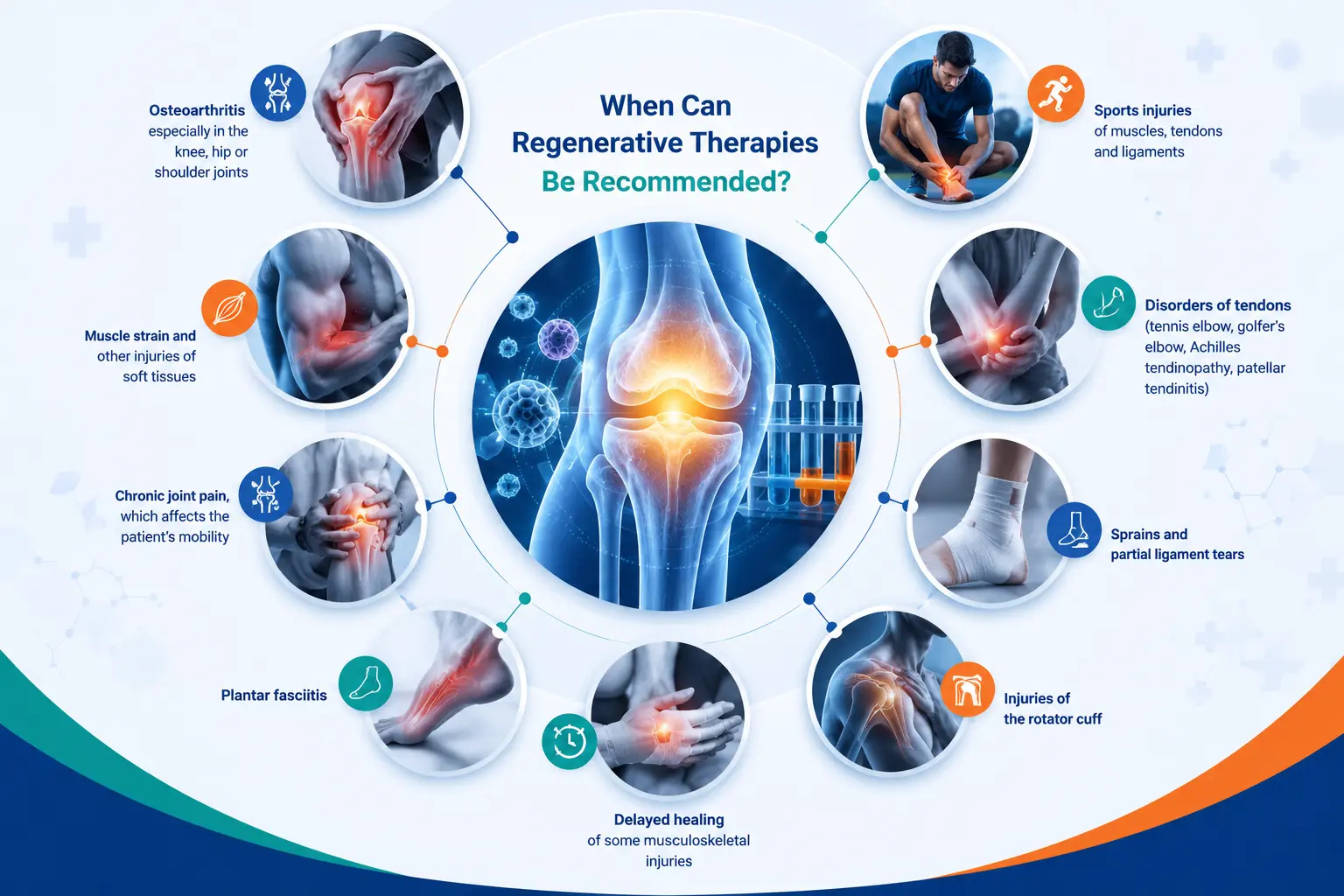
When Can Regenerative Therapies Be Recommended?
Regenerative treatments in Delhi NCR may be recommended for those patients who suffer from chronic pain, decreased mobility, or damaged tissues which cannot heal with conservative treatment methods like medications, physiotherapy, or lifestyle changes.
In case a patient suffers from one of the following conditions, regenerative treatment may be recommended:
- Osteoarthritis, especially in the knee, hip or shoulder joints
- Sports injuries of muscles, tendons and ligaments
- Disorders of tendons (tennis elbow, golfer’s elbow, Achilles tendinopathy, patellar tendinitis)
- Sprains and partial ligament tears
- Damaged cartilages and early joint degeneration
- Injuries of the rotator cuff
- Plantar fasciitis
- Chronic joint pain, which affects the patient’s mobility
- Muscle strain and other injuries of soft tissues
- Delayed healing of some musculoskeletal injuries
The selection of PRP, SCP or BMAC therapy is based on many criteria such as the nature and severity of the disease, the patient’s age and activity level, and the general health status of the patient.
Key Differences: SCP, BMAC, and PRP Therapy
All of these regenerative therapies aim to stimulate the natural process of healing in the body. However, each therapy is characterised by certain distinct features. While both PRP and SCP are extracted from the blood, BMAC is extracted from the bone marrow. This means that apart from being regenerative, this therapy includes growth factors too. The table below highlights the key differences between these therapies.
| Feature | SCP Therapy | BMAC Therapy | PRP Therapy |
| Source | Patient’s blood | Patient’s bone marrow | Patient’s blood |
| Key Components | Highly concentrated platelets and growth factors | Stem cells, progenitor cells, platelets, and growth factors | Concentrated platelets and growth factors |
| Best Suited For | Chronic tendon injuries, joint pain, early osteoarthritis | Cartilage damage, advanced osteoarthritis, complex injuries | Mild-to-moderate arthritis, tendon, ligament, and muscle injuries |
| Procedure | Blood draw and injection | Bone marrow aspiration and injection | Blood draw and injection |
| Invasiveness | Minimally invasive | Moderately invasive | Minimally invasive |
| Recovery | A few days | Several days to 2 weeks | A few days |
Is there a difference between PRP and Stem Cell Therapy in Delhi NCR?
Although both PRP and stem cell therapy are types of regenerative medicine, they are different techniques. PRP is based on the concentration of platelets from the patient’s blood, and stem cell therapy includes using bone marrow aspirate concentrate that comprises stem cells and growth factors.
| Feature | PRP Therapy | Stem Cell Therapy (BMAC) |
| Source | Patient’s blood | Patient’s bone marrow |
| Main Components | Concentrated platelets and growth factors | Mesenchymal stem cells, progenitor cells, platelets, and growth factors |
| Primary Function | Reduces inflammation and promotes tissue healing | Supports tissue repair and regeneration |
| Best For | Mild-to-moderate tendon, ligament, and soft tissue injuries | Cartilage damage, moderate-to-severe osteoarthritis, and complex joint conditions |
| Procedure | Blood is drawn and processed to concentrate platelets | Bone marrow is aspirated and concentrated before injection |
| Treatment Goal | Accelerate the body’s natural healing response | Promote regeneration of damaged tissues and improve joint function |
Which Regenerative Therapy Is Right for You?
- The choice of treatment depends on your condition, its severity, age, activity level, overall health, and recovery goals.
- PRP therapy in Delhi NCR is commonly recommended for mild-to-moderate tendon, ligament, and soft tissue injuries.
- SCP therapy in Delhi NCR may be preferred when a higher concentration of platelets and growth factors is required.
- BMAC therapy in Delhi NCR is often considered for more complex conditions, including cartilage damage and moderate-to-severe osteoarthritis.
- A thorough evaluation by a regenerative medicine specialist is essential to determine the most appropriate treatment for your individual needs.
Limitations of Regenerative Therapy
Just like every other medical procedure, regenerative therapy also has a variety of limitations:
- Not all patients or conditions are suitable for regenerative treatments.
- Results vary based on the severity of the injury and individual response.
- Healing is gradual and may take several weeks or months.
- Some patients may require multiple treatment sessions for optimal results.
- A thorough medical evaluation is necessary to determine the most appropriate therapy.

 WhatsApp