
Sciatica vs Back Pain: How to Tell the Difference
Back pain usually stays local to the lower back and comes from muscle or joint strain. Sciatica is nerve pain that radiates from the lower back down one leg, often with tingling, numbness, or a burning sensation, and needs a different, nerve-focused treatment approach.
You bend down to pick up your bag, and something in your lower back pulls tight. It’s uncomfortable, maybe sharp for a second, but familiar. A little rest, and it eases off.
Then there’s the other kind. It starts deep in your lower back or buttock and jolts down the back of your leg, sometimes all the way to your foot, like someone flipped a switch on a live wire. Sitting makes it worse. So does coughing or sneezing. Some days the leg feels numb or oddly heavy. That’s not “just back pain” anymore, even though it started near your back.
Most people lump the two together because they begin in the same place. But one is a muscle or joint issue, the other is a nerve being pinched, and that difference changes everything about treatment. Manage a nerve problem like a muscle strain for too long, and you risk letting the underlying compression get worse.
The good news? Once you know what to look for, the two are usually easy to tell apart. Here’s how.
Reach Out for Expert Care
What is the Difference Between Sciatica and Regular Back Pain?
Regular back pain usually stays exactly where it started, in your lower back and comes from strained muscles, ligaments, or joints. Sciatica, on the other hand, is nerve pain caused by irritation or compression of the sciatic nerve, and it travels beyond the back into the buttock and leg.
| What to Check | Back Pain | Sciatica |
| What it is | A local problem in the muscles or spinal joints | A “wiring” problem, a pinched nerve sending pain signals far from the actual site of compression |
| Where it’s felt | Rarely goes past the hip | Almost always radiates down one leg, sometimes to the foot or toes |
| What it feels like | Dull, achy, or stiff | Sharp, burning, or like an electric shock |
| What makes it worse | Bending, lifting, or sudden movement | Sitting, coughing, sneezing, or straining |
If your pain stops at your waistline, it’s likely mechanical back pain. If it runs down your leg, you’re probably dealing with sciatica. When in doubt, let the pain’s path be your guide, not just its intensity.
What Does Sciatica Pain Actually Feel Like?
Sciatica has a fairly recognisable “signature”, patients often describe it as a burning, shooting, or electric sensation that starts in the lower back or buttock and travels down the back or side of one leg.
Common descriptions include:
- A hot, searing pain running down the leg
- Pins and needles in the calf or foot
- Numbness along the back or outer side of the leg
- A feeling of heaviness or weakness in the leg, as if it might “give way”
- Pain that worsens with sitting, coughing, sneezing, or straining
Unlike muscular back pain, sciatica is usually one-sided, it affects one leg at a time, not both.
In short, if the pain feels electric, travels below the knee, or comes with tingling and numbness, you’re looking at nerve involvement rather than a simple muscle strain.
What Causes Back Pain vs What Causes Sciatica?
Back pain typically comes from everyday wear and tear, while sciatica points to something pressing on or irritating the sciatic nerve itself. In other words, one is usually about overuse, the other is about compression.
Common causes of regular back pain:
- Poor posture or prolonged sitting
- Muscle strain from lifting or sudden movement
- Weak core muscles
- Age-related wear in the spinal joints
- Stress-related muscle tension
Common causes of sciatica:
- A herniated or slipped disc pressing on a spinal nerve root
- Spinal stenosis (narrowing of the spinal canal)
- Piriformis syndrome, where a deep hip muscle compresses the sciatic nerve
- Spondylolisthesis (a vertebra slipping out of alignment)
- Degenerative disc disease
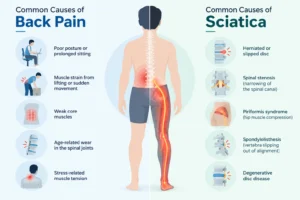
Knowing the cause matters because treating a muscle strain and treating a compressed nerve require completely different approaches. Get the cause wrong, and the treatment simply won’t work, however consistently you follow it.
How Can You Tell If Your Back Pain Is Actually Sciatica?
The quickest way to tell them apart is to ask: does the pain stay in my back, or does it travel down my leg? If it travels, especially past the knee and comes with tingling, numbness, or weakness, it’s sciatica.
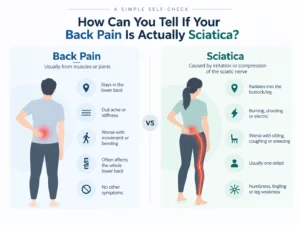
A simple self-check:
- Location: Stays in the lower back (back pain) vs. radiates into the buttock/leg (sciatica)
- Sensation: Dull ache/stiffness (back pain) vs. burning, shooting, electric (sciatica)
- Trigger: Worse with movement/bending (back pain) vs. worse with sitting, coughing, sneezing (sciatica)
- Sidedness: Often affects the whole lower back (back pain) vs. usually one-sided (sciatica)
- Extra symptoms: None beyond stiffness (back pain) vs. numbness, tingling, or leg weakness (sciatica)
If two or more of the sciatica signs match what you’re feeling, it’s worth getting a proper clinical evaluation rather than waiting it out. The sooner the cause is identified, the more treatment options you’ll have.
When Should You See a Doctor for Back Pain or Sciatica?
Most mild back pain settles within a couple of weeks with rest, gentle movement, and basic care, but certain warning signs mean you shouldn’t wait. Ignoring these signs in the hope that things will improve on their own can sometimes cost you precious time.
See a specialist promptly if you notice:
- Pain that has lasted more than 2–3 weeks without improvement
- Numbness, tingling, or weakness that is getting worse
- Difficulty walking, standing, or climbing stairs
- Loss of bladder or bowel control (a medical emergency)
- Pain following a fall, accident, or injury
- Unexplained weight loss, fever, or night pain alongside back pain
These red-flag symptoms, particularly bladder/bowel changes or progressive leg weakness, need urgent medical attention, as they can indicate significant nerve compression that requires prompt intervention.
How Is Sciatica Treated Differently From Regular Back Pain?
Regular back pain often responds well to rest, physiotherapy, and lifestyle changes, while sciatica frequently needs targeted, nerve-focused treatment because the source of pain is compression, not just muscle strain.
For regular back pain:
- Physiotherapy and core-strengthening exercises
- Posture correction and ergonomic changes
- Short-term anti-inflammatory medication
- Heat/cold therapy
For sciatica, treatment is more targeted and may include:
- Nerve-specific physiotherapy and stretching protocols
- Epidural steroid injections to reduce nerve inflammation
- Nerve blocks for targeted pain relief
- Regenerative options like PRP therapy, in select cases, to support healing at the irritation site
- Surgery, only when conservative treatment fails or red-flag symptoms appear
Most cases of sciatica, even fairly stubborn ones, can be managed without surgery when the right combination of nerve-focused, non-surgical treatments is used early. Surgery remains the exception, not the default.
The Bottom Line
Back pain and sciatica can feel similar at first, but they’re not the same condition and they don’t respond to the same treatment. Back pain usually stays local and eases with basic care. Sciatica travels, often comes with numbness or tingling, and needs a nerve-focused treatment plan.
If your pain is running down your leg, waking you up at night, or simply isn’t improving, it’s worth getting it assessed properly rather than guessing. The earlier a pinched nerve is identified, the more treatment options, most of them non-surgical, stay on the table.
At the end of the day, pain is your body’s way of asking for attention, not something to push through in silence. The right diagnosis is what turns weeks of trial and error into a clear, targeted plan and gets you back to moving normally, rather than just managing around the pain.
As a pain management and regenerative medicine specialist in Delhi-NCR, Dr. Namrata Dabas regularly sees patients who’ve spent months treating sciatica as ordinary back pain. If this sounds like what you’re going through, a proper diagnostic evaluation can identify the exact cause and get you onto the right treatment path faster.

 WhatsApp