
Knee Pain When Climbing Stairs: Should I Be Worried?
Knee pain when climbing stairs is one of the most common early warning signs of a joint problem, and in most cases it isn’t an emergency. If you’ve found yourself wondering why my knee hurts going up stairs, the short answer is pressure stairs put 3 to 4 times your body weight through the knee, far more than walking on flat ground. Knee pain climbing stairs causes range from simple muscle weakness or tendon strain to early knee osteoarthritis stairs symptoms like stiffness, grinding, or swelling. The right knee pain climbing stairs treatment depends entirely on which of these is actually going on, which is why stair climbing knee pain arthritis and, say, a weak quadriceps need very different plans.
You take the stairs without a second thought, until one day you don’t. A dull ache on the third step. A sharp twinge under the kneecap on the way up. Maybe you’ve started gripping the railing a little tighter, or quietly switching to the lift when no one’s watching.
Here’s how to understand what your knee is telling you, and when it’s time to get it checked.
Reach Out for Expert Care
Why Do Stairs Hurt More Than Walking?
Ever wondered why your knee hurts going up stairs but feels fine on flat ground? It’s simple mechanics. Walking bends your knee to about 60 degrees; climbing stairs asks for 80 to 90, and going down can push past 100. That extra bend presses the cartilage under your kneecap together more tightly, which is why stairs often expose a problem long before flat ground does.
And you’re not the only one dealing with this. Knee osteoarthritis stairs symptoms that ache, stiffness, or grinding on the way up affect a significant share of Indian adults over 40, with knee pain in women after 40 India showing up especially often. Many also notice knee pain going down stairs worse than up, since going down asks even more of the joint as it works to control your body weight, not just lift it.
So if stairs are the one thing your knee complains about, you’re not imagining it. These are often early signs of knee arthritis and far easier to manage now than later.
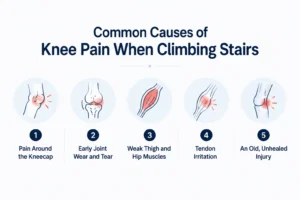
Common Causes of Knee Pain When Climbing Stairs
Not all stair pain comes from the same place and knowing which one fits you makes all the difference in fixing it. Here are the most common knee pain climbing stairs causes we see, from a simple ache under the kneecap to signs of early joint wear.
- Pain Around the Kneecap
Common in younger, active adults. Usually the kneecap tracks slightly off-line as the knee bends, irritating the cartilage behind it, a frequent cause of pain under kneecap climbing stairs. - Early Joint Wear and Tear
The most common cause is past 40. Cushioning cartilage between the bones gradually thins, so the joint surfaces grind under the extra load stairs demand. Pain on stairs while flat-ground walking still feels fine is a classic early sign, often years before an X-ray shows anything. - Weak Thigh and Hip Muscles
Your thighs and hips absorb much of the load when you climb. Desk-bound hours, a sedentary routine, or age-related muscle loss can leave the knee under-supported; one of the most common causes of weak knees climbing stairs. - Tendon Irritation
Inflammation of the tendon connecting kneecap to shin, often after a sudden jump in activity or repetitive stair use. - An Old, Unhealed Injury
A past twist, fall, or sports injury that never fully healed can resurface as stair pain years later, especially with swelling or a catching sensation.
Going Up vs. Going Down: Why the Pattern Matters?
Pain that’s worse going up usually points to effort and muscle load, often weak thighs or tendon irritation. It’s one of the common weak knees climbing stairs causes, and shows up more with a sedentary lifestyle knee joint pain pattern, where the supporting muscles aren’t pulling their weight.
Pain that’s worse going down usually points to pressure on the joint itself, since your knee has to control your body weight as it lowers. This is why knee pain going down stairs worse than up is often linked to early knee cartilage wear symptoms and osteoarthritis.
Neither pattern confirms a diagnosis alone, but noticing knee pain going up and down stairs differently, and mentioning it clearly, is one of the simplest early signs of knee arthritis to watch for, well before it’s time to see a knee pain specialist Delhi-NCR.
When Should You Actually Worry?
Most stair-related knee pain is manageable and improves with the right, targeted treatment, surgery is rarely the first step. But certain signs mean you shouldn’t wait:
- Pain that’s lasted more than 2–3 weeks despite rest
- Visible swelling, warmth, or redness around the knee
- A locking, catching, or giving-way sensation
- Pain that’s started disturbing your sleep
- Pain now present even on flat ground or at rest
- A popping sound at the time of an injury, followed by pain
If any of these apply, it’s time for a proper evaluation rather than more painkillers and waiting it out. The earlier you get an accurate diagnosis, the more treatment options stay on the table; including the non-surgical ones.
You Don’t Need to Jump Straight to Surgery
This is the part most people don’t hear until they’re already sitting in an orthopedic surgeon’s office being handed a surgery date. For the large majority of stair-related knee pain, including moderate osteoarthritis, the first and most effective line of treatment is non-surgical.
Our approach here is regenerative and pain-management-first, built around treatments like:
- SCP and BMAC regenerative injections for more advanced cartilage wear
- PRP (Platelet-Rich Plasma) therapy; using your own blood’s healing factors to support cartilage and reduce inflammation
- Targeted nerve blocks for pain that hasn’t responded to standard measures
- Lifestyle and biomechanical correction; footwear, weight management, and movement pattern adjustments
- Physiotherapy-guided strengthening targeting the exact muscles that protect your knee on stairs
Simple Things You Can Try This Week
The good news? You don’t need a diagnosis to start easing stair pain. These won’t replace proper knee pain climbing stairs treatment if something’s genuinely wrong, but they’re a solid first line of defence, small habits that make a real difference on every flight.
- Take stairs at a controlled pace – Rushing increases impact force
- Strengthen your thigh and hip muscles – Even 10 minutes of targeted exercises, 3-4 times a week, measurably reduces stair pain
- Watch your step height – Where possible, choose a lower first step or use the railing for support, not avoidance
- Don’t ignore consistent swelling – Ice and rest help occasional strain, not a joint that’s swelling repeatedly
- Maintain a healthy weight – Every extra kilogram adds roughly 3-4 kg of force through the knee on stairs
These help, but they’re a starting point, not a substitute for a diagnosis if the pain is persistent. If it’s still bothering you after a few weeks, or keeps returning with every flight, that’s your cue to get it checked rather than push through.
Conclusion
Stair pain isn’t something to just push through, and it isn’t something to panic over either. It’s your knee giving you useful, early information and the sooner you listen to it, the more options you have for a simple, non-surgical fix. If knee pain when climbing stairs has become a regular part of your day, don’t wait for it to get worse before getting it looked at. A proper evaluation now can save you months of discomfort, and quite possibly, a trip to the operating table later.

 WhatsApp