
5 Myths About Regenerative Treatments for Joint and Back Pain
Should you trust the doctor who says regenerative medicine will fix everything, or the one who says it’s just expensive hype? If you’ve spent any time researching regenerative treatments for joint pain, you’ve likely run into this exact contradiction and it’s probably left you more unsure than when you started.
Here’s what’s actually true: regenerative medicine for back pain and joint conditions, including PRP, BMAC, and SCP therapy, works by using your body’s own healing cells to repair damaged tissue and reduce pain, often without surgery. But despite growing clinical evidence, misconceptions about safety, success rates, and how long results actually last continue to hold patients back from a treatment that could genuinely help them.
Dr. Namrata Dabas, a Delhi-NCR based pain management and regenerative medicine specialist with 20+ years of clinical experience, has seen this hesitation firsthand and how often it’s rooted in myth, not medicine. In this blog, we’re breaking down 5 common myths about regenerative medicine, backed by real, evidence-based answers, so you can decide what’s right for you with facts instead of fear.
Reach Out for Expert Care
Understanding Regenerative Therapy for Joint and Back Pain
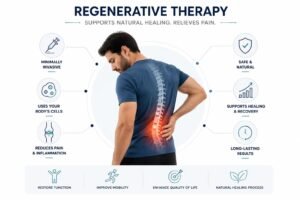
Before we get into the myths, it helps to know what we’re actually talking about. Regenerative therapy for joint and back pain isn’t one single treatment, it’s a category. It includes options like PRP (platelet-rich plasma), stem cell therapy, BMAC (bone marrow aspirate concentrate), and newer approaches like Super Concentrated Platelet (SCP) therapy. Each works a little differently, but the goal is the same: help your body repair damaged tissue naturally, instead of masking pain or replacing joints altogether.
This is also where the regenerative medicine vs surgery debate usually starts. For patients who’ve been told a knee replacement or spinal surgery is their only option, these therapies often come up as a non-surgical treatment for chronic pain worth exploring first and in many cases, a genuine alternative to knee replacement surgery. BMAC therapy benefits, in particular, have made it a preferred choice for patients dealing with more advanced joint degeneration, since it draws on the body’s own bone marrow-derived healing cells.
So why do so many patients still hesitate? Usually, it comes down to five persistent myths, let’s clear them up one by one.
5 Common Myths About Regenerative Medicine — Busted
Now that you know what these treatments actually involve, let’s tackle the myths that keep so many patients from considering them in the first place. Some come from outdated information, others from one bad experience shared online, but none of them hold up against what the evidence and clinical experience actually show. Here’s what’s fact, and what’s simply noise.
Myth 1: “Regenerative Medicine Is Just a Trend With No Real Science Behind It”
Many patients assume regenerative medicine is a passing wellness, something that sounds promising but isn’t backed by real clinical evidence.
So, does regenerative medicine work for back pain? For the right patients, the evidence says yes. PRP and regenerative therapy have been studied for over a decade, with documented improvements in pain and mobility for joint degeneration and disc-related issues. It’s not a fit for every condition, but calling it “unproven” ignores the research that already exists. When it comes to regenerative medicine vs surgery, the honest answer depends on your specific diagnosis not on which treatment sounds more dramatic.
Myth 2: “Regenerative Medicine Doesn’t Actually Work”
This myth usually comes from comparing regenerative treatments to a painkiller expecting instant relief. That’s not how it’s designed to work.
Regenerative medicine success rate varies by treatment and condition, but studies consistently show meaningful improvement for well-selected patients. PRP therapy for joint pain has shown strong results for early-to-moderate osteoarthritis, while stem cell therapy for back pain has helped many patients delay or avoid surgery. Results build gradually over weeks to months, working with your body’s healing process not against the clock.
Myth 3: “It’s Too Risky / Has Serious Side Effects”
Fear of the unknown drives this myth more than actual data does.
Is regenerative medicine safe? For most patients, yes, significantly more so than surgery. Since treatments like PRP and BMAC use your own body’s cells, risk of rejection is minimal. The most common side effects of regenerative medicine are mild; some soreness or swelling for a few days. As for regenerative medicine, most patients compare it to a routine injection, far milder than post-surgical recovery.
Myth 4: “Results Don’t Last or It’s a Temporary Fix”
Results do vary, but “temporary” isn’t the full picture.
How long does regenerative medicine last? Since these treatments repair tissue rather than just masking symptoms, many patients see relief lasting well over a year. BMAC therapy benefits tend to last especially long for advanced joint degeneration, thanks to the richer concentration of healing cells drawn from bone marrow. Occasional follow-ups can extend results further; this is ongoing tissue support, not a fix that simply wears off.
Myth 5: “Only Surgery Can Really Fix Joint or Back Pain”
Surgery has long been positioned as the default fix, so it’s easy to assume it’s the only real option.
But can regenerative medicine help you avoid surgery? For many patients, yes. It has become a genuine alternative to knee replacement surgery for early-to-moderate joint damage, and a reliable non-surgical treatment for chronic pain for disc-related back issues. It’s not a universal substitute; some conditions do need surgery but it deserves a real conversation before ruling it out.
Types of Regenerative Treatments for Joint and Back Pain
Now that the myths are cleared up, it helps to know what’s actually available. Regenerative medicine isn’t a single treatment, it’s a range of options, each drawing on your body’s own healing cells in slightly different ways.
PRP (Platelet-Rich Plasma) Therapy
PRP therapy for joint pain is one of the most widely used regenerative treatments. A small sample of your blood is drawn, processed to concentrate the platelets, and injected directly into the injured area. Platelets carry growth factors that trigger your body’s natural repair process, helping reduce inflammation and support tissue healing. It’s commonly used for early-to-moderate osteoarthritis, tendon injuries, and ligament sprains, with minimal downtime and no need for anesthesia.
BMAC (Bone Marrow Aspirate Concentrate) Therapy
BMAC takes a similar concept a step further. Stem cells and growth factors are drawn from your own bone marrow, concentrated, and injected into the damaged joint or disc. One of the key BMAC therapy benefits is its richer cell concentration compared to blood-derived treatments, making it especially effective for patients with more advanced joint degeneration or disc-related back pain who want to explore options before considering surgery.
SCP (Super Concentrated Platelet) Therapy
Super Concentrated Platelet (SCP) therapy is an advanced evolution of PRP, using a more refined concentration process to deliver an even higher density of healing platelets to the treatment site. While PRP has been the standard for years, SCP is designed to maximize growth factor concentration in a single session, often making it a preferred option for patients seeking stronger regenerative support without additional sessions or a bone marrow-based procedure like BMAC.
| Factor | PRP | BMAC | SCP |
| Derived from | Patient’s own blood | Patient’s own bone marrow | Patient’s own blood (higher concentration) |
| Best for | Early-to-moderate joint pain, tendon/ligament injuries | Advanced joint degeneration, disc-related back pain | Patients wanting stronger platelet concentration in one session |
| Recovery | Minimal recovery time | Slightly longer than PRP | Minimal recovery time |
Who Is a Good Candidate for Regenerative Medicine?
Not everyone is a fit for regenerative treatments, and that’s why getting the right diagnosis matters more than making a quick decision. You may be a good candidate for regenerative treatments for joint pain or back pain if you:
- Have early-to-moderate osteoarthritis, tendon damage, or a ligament injury
- Have ongoing back pain that hasn’t improved with physical therapy or medication
- Want to try a non-surgical treatment for chronic pain before considering an operation
- Are looking for an alternative to knee replacement surgery due to age, recovery time, or personal choice
- Are in reasonably good health overall, with no active infections or certain blood conditions
- Understand that results take time, and want a lasting solution rather than instant relief
Don’t Let Myths Decide Your Treatment
Joint and back pain deserve real answers, not guesswork based on what you read in a random comment section. As we’ve seen, most of the fear and confusion around regenerative treatments for joint pain comes down to outdated ideas, not actual evidence.
Whether it’s PRP, BMAC, or SCP, regenerative medicine has helped many patients find relief without surgery, and without the risks that come with it. The real question isn’t whether it works, it’s whether it’s right for you.

 WhatsApp