
Frozen Shoulder: Surgery or Can It Heal Without It?
Most frozen shoulders heal without surgery. With timely pain management, most patients regain full movement within 1- 3 years. Surgery is only considered when conservative treatment fails.
Can’t lift your arm to reach the top shelf, or wash your hair without wincing? If your shoulder has quietly gone from “a little stiff” to “barely moves,” you’re not imagining it, and you’re not alone. This is frozen shoulder, and here’s the reassuring part first: most people get better with the right frozen shoulder treatment, no scalpel required. Surgery is usually the last resort, not the first step. In this guide, we’ll walk you through what a frozen shoulder without surgery actually looks like, from physiotherapy to injections, how adhesive capsulitis treatment works stage by stage, and the honest signs that tell you when it’s time to consider surgery instead of waiting it out.
Reach Out for Expert Care
What is a Frozen Shoulder?
Frozen shoulder, medically known as adhesive capsulitis, happens when the soft tissue capsule surrounding your shoulder joint becomes inflamed and gradually tightens. Think of that capsule as a stretchy sleeve holding your joint together; when it thickens and loses flexibility, your shoulder simply can’t move the way it used to. It’s not an injury you can point to, there’s usually no fall, no lifting mishap, just a slow, frustrating stiffening that sneaks up over weeks or months.
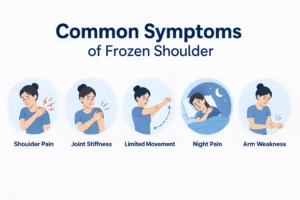
The most common symptoms are a dull, aching pain (often worse at night) and a stiffness that makes everyday movements such as reaching, dressing, driving etc feel effortful. As for frozen shoulder causes, the honest answer is that doctors don’t always know why it starts. But certain things do raise your risk: prolonged shoulder immobility after surgery or injury, being over 40, and notably frozen shoulder and diabetes are closely linked, with diabetics facing a significantly higher chance of developing it. Understanding what’s actually happening inside your shoulder is the first step toward the right frozen shoulder treatment, so you’re not just managing symptoms blindly.
The 3 Stages of Frozen Shoulder: Freezing, Frozen, Thawing
Frozen shoulder typically progresses through three overlapping stages: freezing, frozen and thawing. The duration and severity of each stage can vary considerably from person to person.
| Stage | Typical duration | Main symptoms | What may help |
| Freezing | Usually several weeks to several months | Pain progressively increases, often with night pain, while shoulder movement gradually becomes more restricted. | Pain management and appropriately guided, gentle movement or physiotherapy |
| Frozen | Often several months | Pain may gradually become less severe, but stiffness and restricted shoulder movement are more prominent. | Individualised physiotherapy, gentle stretching and exercises suited to the level of irritability |
| Thawing | Often several months to 2 years or longer | Pain and stiffness gradually improve, with progressive return of shoulder movement. | Progressive frozen shoulder exercises and physiotherapy to restore movement and function |
The time spent in each stage is not predictable. Some people recover within a shorter period, while symptoms and movement restrictions can persist for 2- 4 years in some cases. Complete recovery is not guaranteed without appropriate management, so persistent symptoms should be assessed rather than simply waiting for the shoulder to “thaw” on its own.
What happens in each stage?
Freezing stage: Pain gradually increases, often disturbing sleep, while shoulder movement starts becoming limited.
Frozen stage: Pain may ease, but stiffness becomes the main problem, making everyday shoulder movements harder.
Thawing stage: Pain and stiffness gradually improve, allowing shoulder movement and function to return.
Can Frozen Shoulder Heal Without Surgery?
Yes, frozen shoulders can often improve without surgery. Treatment may include pain management, frozen shoulder physiotherapy, targeted exercises and injections, depending on the stage and severity of the condition.
Non-surgical treatment for frozen shoulder
- SCP/PRP therapy: Platelet-based treatments such as SCP therapy and PRP are being studied for frozen shoulders, with emerging evidence suggesting potential benefits for pain and shoulder movement. However, they are not yet as established as conventional treatments.
- BMAC therapy: BMAC is being explored as a regenerative treatment for musculoskeletal conditions, but there is currently limited evidence specifically supporting its use for frozen shoulders. It should therefore be considered selectively rather than presented as a standard treatment.
- Hydrodilatation: Hydrodilatation for frozen shoulder uses fluid injected into the joint to stretch the tight capsule and improve movement in suitable patients.
- Corticosteroid injection: A corticosteroid injection for shoulder pain may help reduce pain, particularly during the early, painful stage.
- Physiotherapy and exercises: Guided frozen shoulder exercises can gradually improve shoulder flexibility and movement.
If significant pain and stiffness continue despite appropriate non-surgical frozen shoulder treatment, procedures such as manipulation under anaesthesia or arthroscopic capsular release may be considered.
When Is Surgery Actually Needed for Frozen Shoulder?
Most people with frozen shoulders do not need surgery. It may be considered when significant pain or stiffness continues despite appropriate non-surgical frozen shoulder treatment and limits everyday activities.
Surgery may be considered when:
- Symptoms persist despite several months of physiotherapy, exercises and other treatments.
- Severe stiffness continues to restrict shoulder movement and daily activities.
- Pain or functional limitations remain despite appropriate treatment.
If needed, frozen shoulder surgery may involve manipulation under anaesthesia or arthroscopic capsular release, depending on the individual case.
A specialist will consider the severity of symptoms, stage of the condition and response to treatment before recommending surgery.
Frozen Shoulder or Rotator Cuff Injury: How to Tell the Difference?
Frozen shoulder and a rotator cuff injury can both cause shoulder pain and restricted movement, but they affect the shoulder differently.
| Frozen Shoulder | Rotator cuff injury |
| Stiffness is usually the main problem, with both active and passive movement restricted. | Pain and weakness are more prominent, particularly when lifting or rotating the arm. |
| Pain may be worse at night and gradually settle as stiffness increases. | Pain may follow an injury or repetitive overhead activity and can worsen with specific movements. |
| Commonly develops gradually without a clear injury. | Often linked to an injury, overuse or tendon-related changes. |
Because symptoms can overlap, a clinical examination is important for an accurate diagnosis. In some cases, imaging may also be recommended to distinguish frozen shoulder vs rotator cuff injury and guide appropriate treatment.
Conclusion
A frozen shoulder can make simple things like reaching overhead, getting dressed or sleeping comfortably surprisingly difficult. But the good news is that frozen shoulder treatment does not usually mean surgery.
With the right approach, many people improve with frozen shoulder physiotherapy, exercises, pain relief and other non-surgical treatments, depending on their symptoms and stage of the condition. Surgery is generally considered only when significant pain and stiffness continue despite appropriate treatment.
If your shoulder is becoming increasingly stiff or painful, don’t simply wait for it to “thaw”. Getting an early assessment can help identify the problem and find the right treatment to get you moving comfortably again.

 WhatsApp